 https://innews.media/uploads/news/2024-07/_innews_10b71cf7c2565bf19a3681245_o.jpg
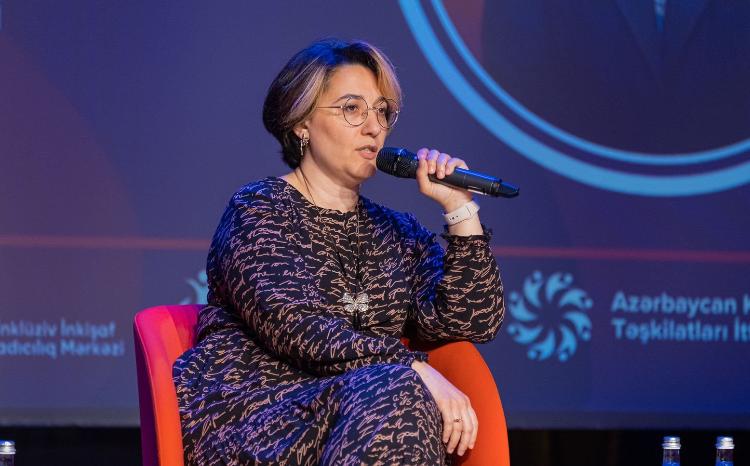
interview with Rena Tahirova, Chairperson of Sustainable Development and Corporate Impact Committee of the American Chamber of Commerce in Azerbaijan
American Chamber of Commerce in Azerbaijan (AmCham) considers the significant impact of private sector on addressing global issues such as climate change and sustainability. The Chamber believes that companies must understand their role in shaping climate policy, contributing to sustainability efforts, and leveraging opportunities for innovation and development. By fostering dialogue and cooperation between the private sector, government, and other stakeholders, the Chamber aims to promote meaningful actions towards a more sustainable and resilient future. We discussed these activities with the Chair of the AmCham Sustainable Development and Corporate Impact Committee, Rena Tahirova.
Rena, for the first time in Azerbaijan's history, AmCham is releasing the Sustainability Handbook. What is this handbook?
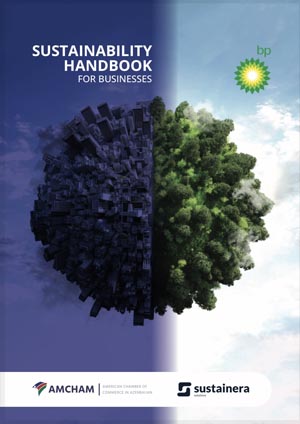 This handbook is a comprehensive guide aimed at supporting and enhancing the private sector's knowledge in the areas of environmental, social, and governance (ESG) practices. The AmCham Sustainability Handbook serves as a practical tool offering detailed approaches and various perspectives on sustainable development that the private sector can apply in both daily operations and strategic goal setting.
Why did you choose to release this practical guide now?
We have long desired to release a Sustainability Handbook, having discussed it for about 2-3 years. We are very pleased that, in partnership with Sustainera Solution and with the support of bp, this opportunity has now arisen. Currently, the integration of sustainable development principles into corporate management standards has become an crucial. Companies are facing situations where adherence to ESG principles is a prerequisite for continued business development, but in practice, it is not always clear which standards are applicable, how to apply them, and how to set long-term and short-term goals. I believe this handbook will become a desk reference for business development, sustainable development, and HR professionals.
The relevance of the AmCham Sustainability Handbook lies in its accessible language and clear information on existing trends, goals, and standards. Considering that the implementation of ESG standards is currently a priority for the state, its relevance is undeniable. Moreover, the universality of the AmCham Sustainability Handbook makes it interesting not only for the private sector but also for professionals in government structures and students.
Lastly, in developing Handbook, we aimed to create a resource that promotes the exchange of practices and helps companies mitigate environmental and social risks. It is widely acknowledged that non-financial risks now dominate over financial ones, related to social and environmental issues. Therefore, our goal in enhancing corporate governance through the implementation of ESG standards is risks reduction and achieving positive change.
Rena, we use the term "Sustainable Development"... But what is "Unsustainable Development"?
Sustainable development entails a harmonious blend of economic growth, social justice, and minimal impact on the environment. In contrast, unsustainable development is a model primarily focused on economic achievements aimed solely at profit generation and capital accumulation. Unsustainable development results in environmental degradation, social inequality - a significant gap between the rich and the poor, deteriorating living conditions, and economic instability. Often, businesses are focused solely on short-term goals, only on the present moment, which frequently leads to economic instability. Sustainable development, on the other hand, involves a long-term strategy consisting of short-term steps.
Thank you so much... Rena, there is an opinion that sustainable development is an expensive pleasure... Can businesses calculate how beneficial it is in the long or medium term to be sustainable?
Yes, the opinion that sustainable development is indeed an expensive endeavor and may not always be affordable for small and medium-sized enterprises is widely spread and it is true. Because ESG approach is required to innovations, additional investments in new technologies, science based approach which may not always be within the means of medium and small entrepreneurs. In such situations, the support of international and governmental financial institutions is important, including grants, loyal loan programs, and the provision of expert and advisory services. Implementing sustainable development approaches at the initial stage requires investment, which may initially seem unreasonably expensive, but in the long run, it brings significant benefits to businesses that are concrete and measurable. For example, this includes cost savings on energy resources and production costs. For example, by effective waste management and circularity approach the initial waste can become a row material in production circle.
As I already mentioned the sustainable development stimulates innovative approaches, and any innovation always gives a competitive advantage in the market - it not only increases productivity but also employee loyalty - because one of the key principles of the social part of ESG is a social approach, transparency, accountability, compliance and human rights. Companies that invest in sustainable development practices today will be in a more advantageous position tomorrow, possessing advantages in terms of specific economic resources and reduced risks. To demonstrate all the benefits of sustainable development practices, the AmCham Sustainability Handbook was created, including.
When the Handbook will be released?
 The handbook will be available from 1st August on AmCham website - https://amcham.az/en/other-publications
Thank you for the insightful interview, Rena.
Thank you for your interesting questions.













Ən son xəbərləri səhifəmizdən də izləyin