 https://innews.media/uploads/news/2025-09/_innews_bbc54a865cfa12667bd3290a1_o.jpg
Azerbaijan Railways CJSC (ADY), part of AZCON Holding, has completed another milestone project that marks a strategic transformation in the country’s transportation and logistics sector. The Ujar-Hajigabul section (122 km) of the Baku-Boyuk Kasik railway line has been fully switched to alternating current (AC) power, with successful test runs of freight and passenger trains already carried out. This development represents more than a technical upgrade – it is a bold step that strengthens Azerbaijan’s transport infrastructure and removes one of ADY’s long-standing operational bottlenecks.
To enhance efficiency, reduce energy consumption, and raise safety standards, communication and signaling systems along the Ujar–Hajigabul section have been modernized. As part of this work, ADY has introduced a Multi-Process Management (MPM) system – an advanced technology that allows signaling, communication, and control processes to operate in parallel. This shift to centralized, modern management reduces train intervals, increases freight handling capacity, and contributes to safer, faster, and more reliable operations.
Switching to AC power improves the traction capability of electric locomotives, enabling higher freight volumes, faster speeds, and simplified operations, while also delivering significant energy savings and cost optimization. Globally, AC systems are the backbone of modern railways – from Europe to China – and are widely applied on mainline corridors, international routes, and high-speed networks. By adopting the same approach, Azerbaijan ensures that its strategic rail infrastructure aligns with global standards and is ready for long-distance, high-capacity operations characterized by speed and stability.
The implementation of the AC system is more than an engineering success, it symbolizes the future development of Azerbaijan’s transportation geography. With this upgrade, freight volumes are set to grow, transportation costs will decline, and transit routes across Azerbaijan will become more competitive compared to sea and road transport. This, in turn, strengthens Azerbaijan’s role on the international logistics map, positioning the country as a reliable and competitive player on the logistics map.
This transformation is fully aligned with the transportation strategy defined by President Ilham Aliyev, which places a strong emphasis on reinforcing Azerbaijan’s status as a transit country and elevating the role of railways in the nation’s economic and geopolitical landscape. Strategic projects such as increasing the annual freight capacity of the Baku-Tbilisi-Kars line to 5 million tons and integrating Baku Port with the railway network are reshaping supply chains, minimizing time losses, and reducing logistics costs. By ensuring cargo flows directly from sea to rail, the integration of Baku Port further accelerates operations and creates stronger competitive advantages for Azerbaijan in global trade.
The transition to AC technology is not only a technical modernization, but also a landmark step in line with ADY’s broader Environmental, Social, and Governance (ESG) commitments. By sharply reducing diesel use, improving energy efficiency, and lowering carbon emissions, ADY demonstrates its strong alignment with Azerbaijan’s green development agenda. This bold upgrade reinforces the country’s appeal for sustainable investment and shows that the railway is moving beyond efficiency gains to become a cleaner, more competitive, and future-ready mode of transport.
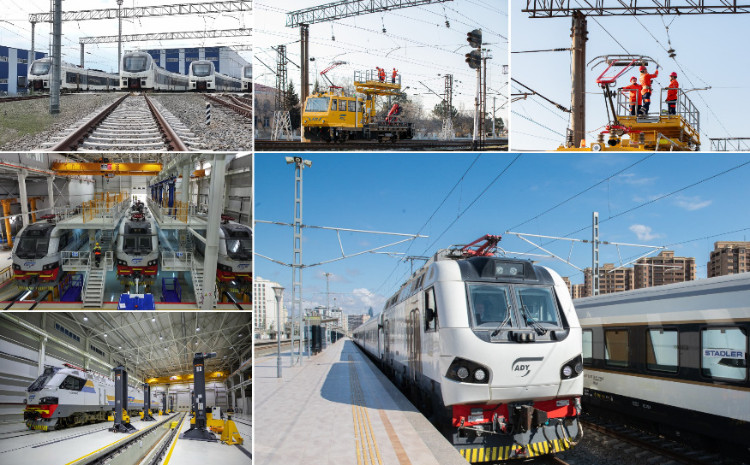
At the same time, ADY continues to modernize its rail fleet. A significant portion of the fleet has already been renewed to meet international standards, enhancing transport flexibility, train speeds, and overall service quality. Today, ADY operates 15 modern passenger trains and 50 locomotives capable of running on AC power. Of these, 6 passenger trains and 40 locomotives run exclusively on AC, while 9 passenger trains and 10 locomotives can operate on both direct current (DC) and AC. This modernization complements the energy system upgrade, ensuring that ADY’s fleet is future-ready and able to handle growing demand in freight and passenger services.
This bold upgrade positions Azerbaijan as a leader in sustainable logistics, ensuring that its railway system is both economically efficient and ecologically sound, and reinforcing the country’s ambition to be a central hub in international transportation networks.
The shift to AC power also resolves several long-standing challenges in railway operations. The intervals between trains are reduced, energy supply is stabilized, and operations are managed more efficiently through centralized systems. These improvements make both domestic services and international transit faster, more reliable, and more sustainable.
Earlier, ADY successfully transitioned the Boyuk Kasik-Gandja (141 km) and Gandja-Ujar (113 km) sections to AC power. The final phase – Hajigabul–Baku (127 km) – will be completed in 2026-2027, bringing the entire Baku-Boyuk Kasik mainline under AC power. Once completed, this flagship corridor, which carries the bulk of Azerbaijan’s international freight traffic, will be fully modernized in line with global standards and capable of supporting the growing role of the Middle Corridor in Eurasian trade.









Ən son xəbərləri səhifəmizdən də izləyin